Translating ServiceNow IRM’s OOB Features Into Language Your Stakeholders Understand
From Platform Features to Business Outcomes: How to Talk About IRM Without Losing the Room
I pulled up the dashboard I'd built, which visualized our compliance posture by entity class, control attestation rate, and indicator pass/fail breakdown. I knew the logic behind every widget and metric on that screen.
Then the VP of Finance leaned forward and asked: “This is helpful, but can you tell me in plain terms are we covered or aren’t we?”
I knew the answer. But I had about 90 seconds to translate three months of implementation work into something a finance executive could act on. The platform language I had been living in with citations, entities, control objectives, indicators was precise and accurate and completely useless at that moment.
That gap between platform vocabulary and stakeholder vocabulary is one of the most underestimated challenges in IRM implementation. It is not a presentation problem. It is not a soft skills problem. It is a strategic one. When stakeholders cannot understand what the platform is telling them, they stop trusting it. When control owners do not understand what they are attesting to, attestation quality drops. When executives do not connect dashboards to business risk, they do not fund the work.
Article 3 of this series covered what ServiceNow IRM gives you out of the box. This article covers the other half: how to explain it to everyone who needs to act on it.
Why This Gap Costs More Than You Think
A platform can be technically sound and organizationally ignored at the same time. I have seen it happen. An IRM implementation that is fully configured, properly scoped, and generating accurate compliance data sitting unused because no one outside the GRC team knew how to read the outputs.
The failure mode is not always a bad dashboard or missing data. It is often a language mismatch that compounds over time. Control owners disengage when they do not understand what they are confirming. Executives deprioritize IRM budget when they cannot connect the platform’s outputs to business risk. Auditors ask for evidence the team has to manually reconstruct because no one built the translation layer into stakeholder-facing reporting.
“The platform’s vocabulary — citations, entities, indicators, attestations — doesn’t naturally map to how executives, control owners, or auditors think about their work. The platform is powerful. But the language it uses is ours, not theirs.”
Closing this gap is not about dumbing things down. It is about bridging two accurate framings of the same reality. The platform view is precise. The stakeholder view is decision-oriented. Your job as a practitioner is to hold both fluently.
Translating the Four Core OOB Concepts
These are the platform terms that show up in almost every stakeholder conversation I have had. Each one has a technically precise meaning that most non-practitioners cannot easily parse and a business-language equivalent that lands immediately.
The format below shows each translation: what the platform calls it, what it actually means in implementation terms, what to say instead, and a sentence you could actually say out loud in a meeting.
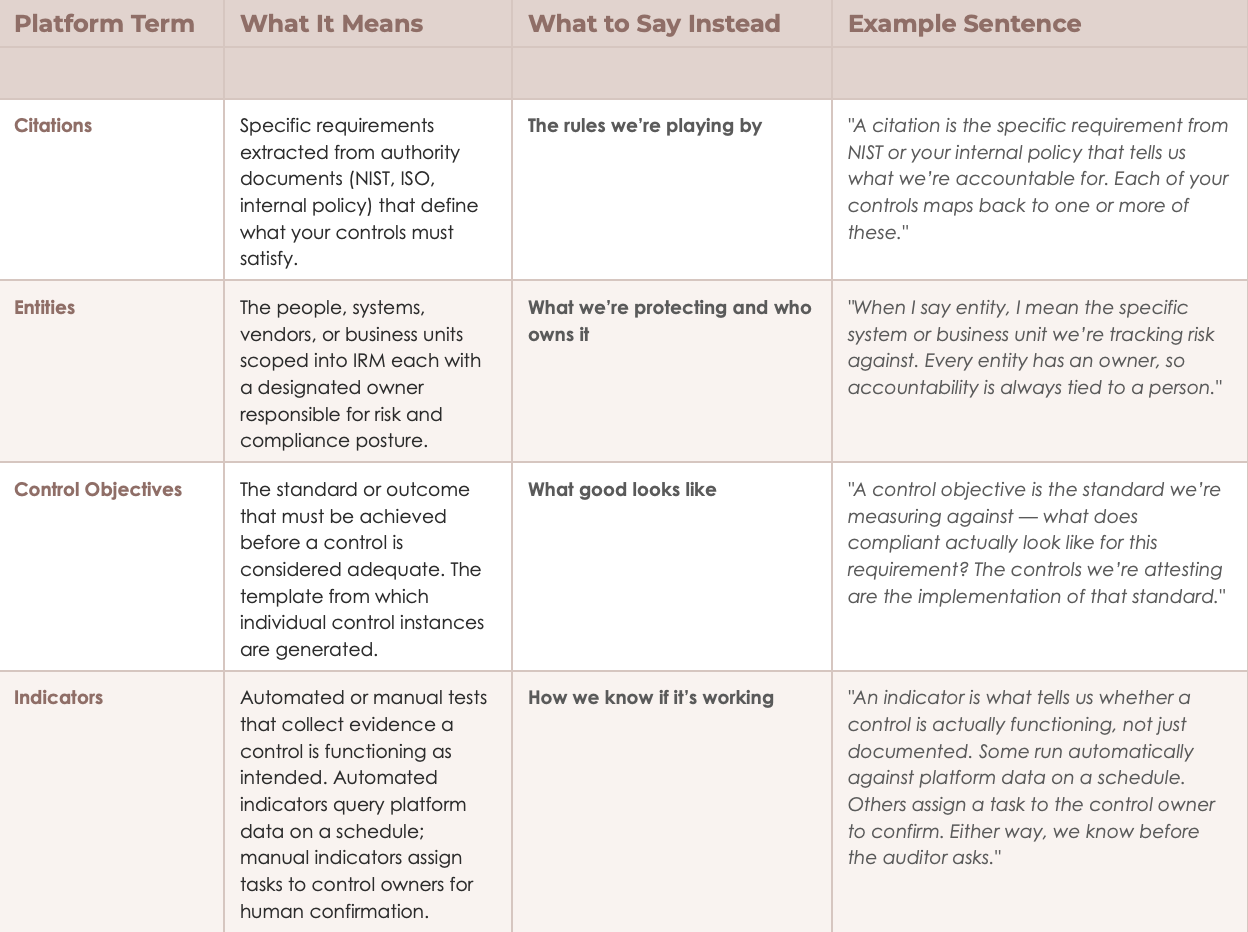
A few notes on using these translations effectively. First, lead with the stakeholder frame before you introduce the platform term not the other way around. Say “the rules we’re playing by” first, then explain that the platform calls them citations. Second, the example sentences in the table are starting points, not scripts. Adapt them to the vocabulary your org already uses. If your executives call it “control evidence,” that is your anchor word, not “indicator.” Third, consistency matters more than perfection. Pick your translation for each term and use it the same way every time across meetings, documents, and dashboards.
Translating OOB Reports and Dashboards
The reporting capability that ships with ServiceNow IRM is genuinely useful. Control health summaries, compliance posture by entity, indicator pass/fail trends, policy exception counts these dashboards give practitioners real visibility. The challenge is that most stakeholders approach a dashboard with a decision question in mind, not a curiosity about the data structure.
The three questions I hear most often in steering committees are: Are we meeting our obligations? Are our protections actually working? Are things getting better or worse? Those questions map to platform capabilities, but not one-to-one to the default dashboard titles.
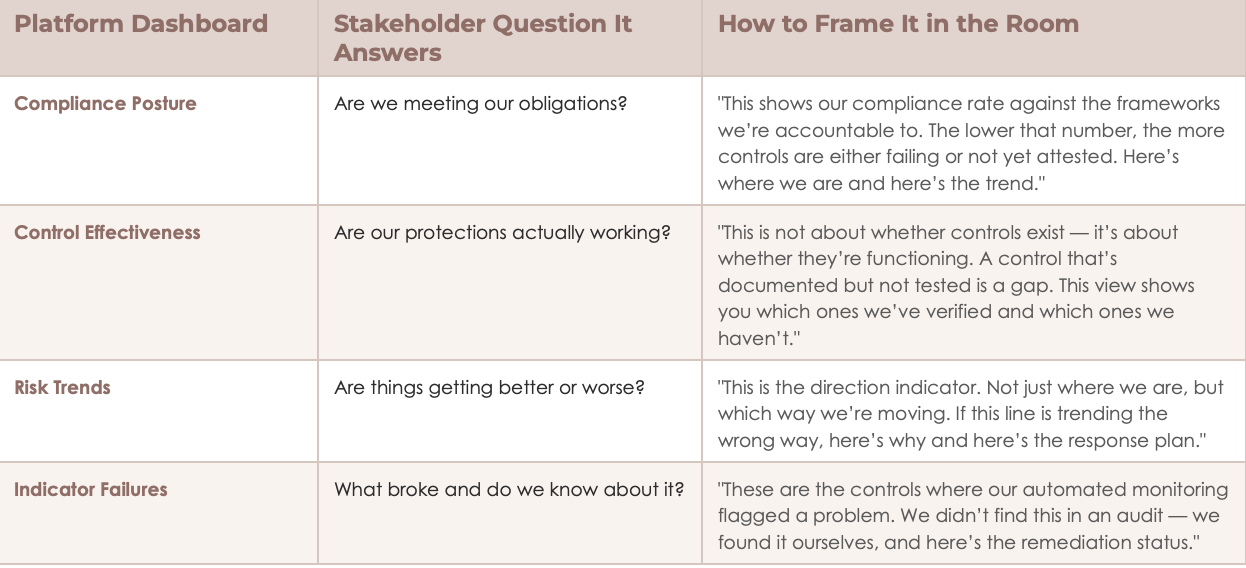
One configuration decision that pays compounding dividends: rename your dashboard widgets and chart titles to match your organization’s vocabulary, not the platform’s defaults. This is not cosmetic. When a widget is labeled “Compliance Posture by Entity Class,” a VP reads it differently than when it says “Compliance Coverage by Business Unit.” The underlying data is identical. The executive’s willingness to engage with it changes significantly.
ServiceNow IRM allows you to customize widget titles, dashboard names, and report labels. Use that capability intentionally. Treat the language on every stakeholder-facing view the same way you treat any other configuration decision because that is exactly what it is.
A Repeatable Translation Framework
The four translations in Section 2 cover the most common platform terms. But stakeholder conversations will take you into territory beyond those four, and you need a mental model that holds up across all of them.
Here is the question I use every time I need to explain an IRM concept to someone outside the platform:
“What decision does this help someone make?”
Then explain the concept in terms of that decision. That framing cuts through almost every translation problem because it forces you to anchor the explanation in why the concept exists, not just what it is.
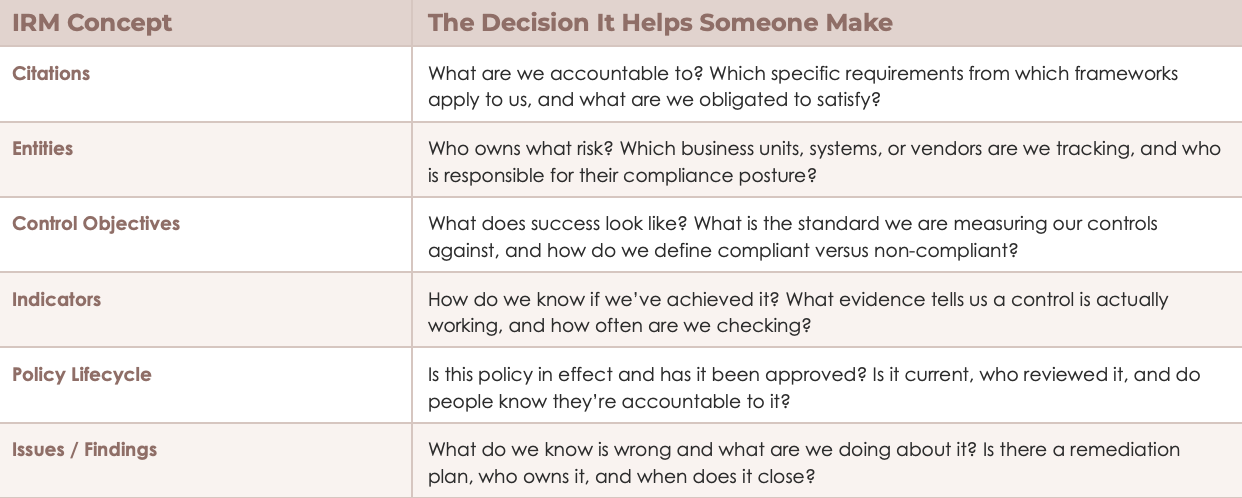
This framework is also portable. Once your stakeholders internalize it that every IRM concept exists to help someone make a specific decision they start asking better questions. Instead of “What is an indicator?” they start asking “How often are we checking?” That is the conversation you want to be in.
The OOB Cheat Sheet referenced at the end of Article 3 maps each platform feature to these decision questions. Download it from thesaasceboutique.com and use it as a leave-behind the next time you present to a steering committee. It makes the translation portable for your audience, not just for you.
Translation Is a Strategic Skill, Not a Soft One
The core message is this: an IRM practitioner's credibility extends beyond mere platform configuration. True value lies in the ability to link your work to key business objectives. This crucial connection is the difference between being a simple implementer and a trusted advisor.
Implementers build the system. Advisors make the system matter to the people who fund it, use it, and get audited against it. The translation skill is how you move from one to the other. It is how you get the budget approved for the next phase. It is how you get control owners who show up and actually engage with their attestations. It is how you turn a compliance dashboard into a governance conversation.
The practitioners I have seen build the most influence in their organizations are not necessarily the ones who know the platform most deeply. They are the ones who can stand in a steering committee, look at that dashboard on the screen, and answer the question the VP of Finance just asked in 90 seconds, in language that lands.
That is a skill you can build deliberately. This article and Article 3 are two parts of the same toolkit.
Practitioner question for the comments: Which of these four translations has been the hardest to get right in your organization? I am curious whether citations or control objectives cause more confusion in practice let me know where you have gotten stuck.
Listen & Learn More
This article pairs with Episode 3 of Let’s Talk IRM OOB Features of ServiceNow IRM where we go deeper on the platform capabilities behind each of these translation moments. If you read Article 3 first, this episode connects the technical foundation to the stakeholder-facing work.
Download the OOB Cheat Sheet at thesaasceboutique.com a quick-reference tool that maps platform features to decision questions and stakeholder-ready language. Designed to be used in meetings, not just read once.
If you missed Article 3 What ServiceNow IRM Actually Gives You Out of the Box start there. This article assumes that foundation. Coming in May: Article 5 covers implementation planning, where the OOB reality and the translation work come together into a structured rollout approach.
Sources & References
Article 4 draws primarily from practitioner experience and the ServiceNow IRM product documentation. Technical terminology and feature references verified against ServiceNow official documentation and community sources.
[1] ServiceNow IRM Product Documentation — Policy and Compliance Management: docs.servicenow.com
[2] ServiceNow Community: IRM/GRC Architecture — entity, control objective, citation data model overview
[5] Perficient: 5 Implementation Patterns for ServiceNow GRC — control and entity lifecycle patterns